Edmonton’s Historic Lofts

Where Architecture Meets Identity

Edmonton's historic loft buildings represent one of the rarest categories of real estate in Canada. There are only approximately 200 "true" historic loft condo units in the entire city. These are not modern imitations of industrial style — they are authentic conversions of warehouses, commercial blocks, and early apartment buildings constructed during Edmonton's pre-World War I boom period, between roughly 1910 and 1929. Once the last viable conversion is complete, the supply is permanently fixed. No developer can ever build new ones.

The City of Edmonton maintains a Register of Historic Resources listing 76 Municipal Historic Resources, 190 A-List Resources, and 305 B-List Resources — a total of 571 sites. Of that number, only a small fraction have been converted into residential loft units. Nine heritage buildings along the 104th Street Promenade alone hold A-List status. The buildings profiled below collectively represent the core of Edmonton's historic loft inventory.
Iconic Historic Loft Buildings in Edmonton

Phillips Lofts | 10169 104th St.

Built: 1913 | Architects: Purcell & Foote

The Phillips Building is a five-storey rectangular brick commercial building located on four city lots a block north of Jasper Avenue on 104th Street in Edmonton's original historic warehouse district. It is architecturally significant as a representative example of commercial warehouse design that characterized Edmonton's growth during the pre-World War One economic boom. Originally leased to the Western and Cartage Company, it was built to store manufactured goods for regional and northern distribution.

Completed in 1913 and touted to be a made-in-Edmonton building, the Phillips Building was designed and constructed by Purcell and Foote, local architects and builders, and the Edmonton firm of Alsip and Company supplied locally made sand lime brick. A unique feature was an internal 22-foot arcade running through the centre of the building to rear loading docks — described at the time as a "first of its kind in Edmonton."

The building was severely altered in the 1960s when a façade of metal cladding, marble, and beige stone was applied, masking its original appearance for nearly 40 years. In 2000 it was slated for demolition, but public outcry saved it. Due to a public outcry, the building was saved from the wreckers ball and was designated as a Municipal Historic Resource in 2001. In 2002, renovations were completed by Chandos Construction to bring the building back to its original character with its front façade restored to its original 1912 appearance.


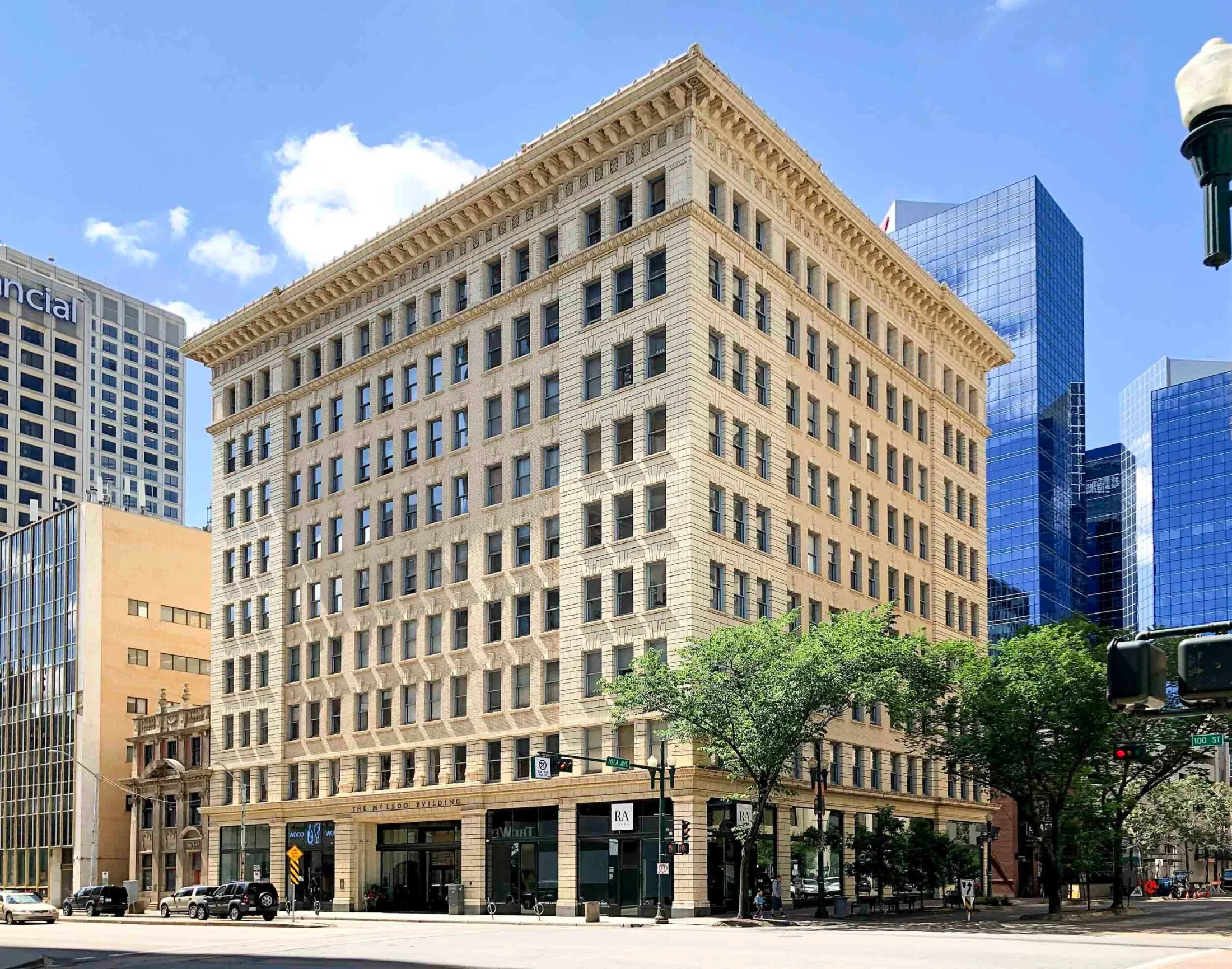
McLeod Building | 10134 100th St

Built: 1915 | Architect: J.K. Dow

The McLeod Building is a nine-storey brick and terra cotta structure in the Chicago Commercial style on a prominent corner in downtown Edmonton. It is valued for its landmark status, its architecture and its unique decoration, which reflects the height of Edwardian-era architectural influences in Edmonton. Noted as the best local example of its kind, its style reflects a refined neo-classicism that was reinvented at the Chicago World's Fair of 1893 and came into popular use in American cities in the early part of the twentieth century. The building was patterned after the Polson Block in Spokane, Washington and was designed by the same architect, J.K. Dow. 

It is the only remaining terracotta-clad building in Edmonton. The McLeod is the finest example of Chicago School architecture in Edmonton, featuring classical architectural detailing including keystones, voussoirs, rustication, antefixae, triglyphs, modillion and polychromed friezes, ornate pillars, and ornate cornices. 

The grand lobby features marble walls, a coffered ceiling, elegant sitting areas, a spacious foyer, a statement staircase, and three elevators. Inside, enjoy a bright open concept layout with white cabinetry, original terrazzo flooring, and large west-facing windows.


Seventh Street Lofts 10309 107th St.

Built: 1929; converted c. 2000 | Conversion Architects: DUB Architects

Set in Edmonton's warehouse district, Seventh Street Lofts adopts a scale and industrial character compatible with existing, older buildings. The project is composed of three distinct buildings: Phase 1 — conversion of a 1929 brick and heavy timber John Deere warehouse to 40 apartments, half of which are 2-storey units. Phase 2 — a new 36-unit building with steel stud bearing walls joins the two older structures. dub architects

Originally built in 1929 as the John Deere Warehouse, this striking brick and beam landmark has been reimagined by DUB Architects into one of the city's most coveted addresses for artists, musicians, entrepreneurs, and urban explorers. Units feature soaring 13-foot fir-beam ceilings, original cedar wood ceilings, exposed brick walls, maple hardwood floors, and large west-facing windows. The National Trust for Canada recognized this conversion for its sensitive preservation of the warehouse's industrial scale and character.

MacCosham Lofts | 10301 109St.

Built: 1922 | Conversion Architects: DUB Architects

The MacCosham Loft building has been a fixture in downtown Edmonton since the 1920s. Located in what was once the warehouse district, these authentic industrial-style lofts are situated within walking distance to Rogers Place and the Ice District. 

Converted into warehouse lofts by DUB Architects in 2000, Maccosham Lofts is a standout example of adaptive reuse done right. The building retains many of its original industrial elements. While the original brick facade was altered decades earlier, the conversion respected the building's industrial roots. 

It is now a mixed-use development of underground parking, shops, a computer training school, and two floors of loft housing above. The central sky-lit atrium allows for light to penetrate into the core of this large square plan. dub architects

The standout features are the historic vibe with massive fir posts and beams throughout, exposed brick walls, the industrial style elevator, high ceilings constructed with 2x10 on-edge timbers, and all the industrial style exposed pipes and ductwork throughout. Units in this building almost never come to market — it is among Edmonton's most tightly held historic loft addresses.


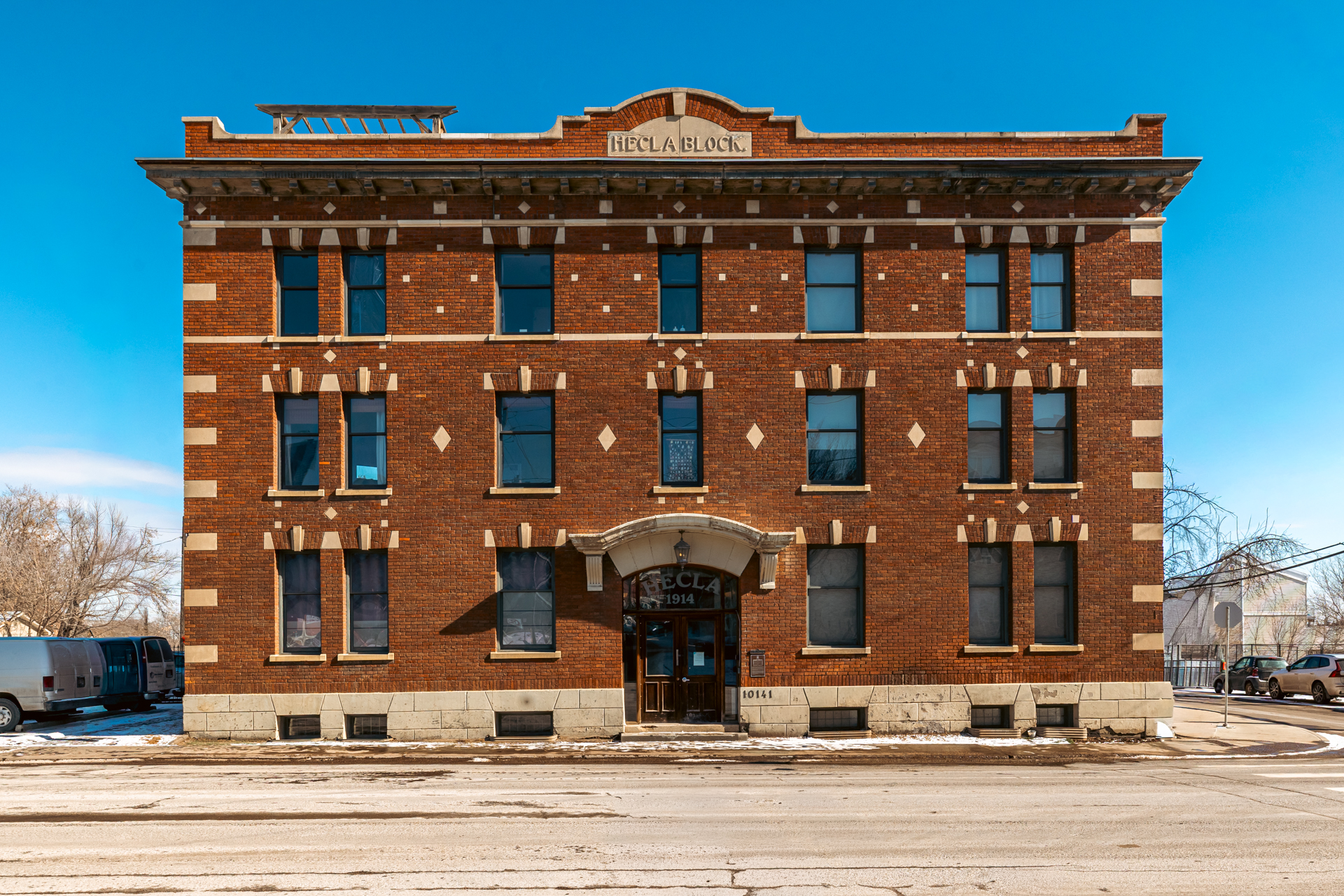
Hecla Lofts | 10141 95th St

Built: 1914 | Architects: David Hardie & John Martland

The Hecla Block represents Edmonton's first generation of apartment buildings, noted for not having ground floor commercial space. Located on what was the edge of the city in the Boyle community, it was built for Edmonton's blue-collar, working class, and served a growing demand for residential accommodation during the pre-World War One construction boom. 

Icelandic-born John Johnson was the builder and owner. He named it after Mount Hecla, Iceland's largest and most celebrated volcano. Built in 1914 and designed by architects David Hardie and John Maitland, the Hecla Block has served exclusively as a residence over the decades.

The building initially had seven one-bedroom suites per floor, common water closets and baths on each level, a basement, and a skylight over the stairwell. Hard times fell, and in 1924, Molson's Bank foreclosed on the building. It subsequently changed hands many times until the Edmonton Board of Health declared it unfit for habitation in the 1990s. Then a fire virtually gutted the interior. "It was a burnt-out hulk, really terrible," said Frank Bowen, a commercial real estate appraiser who restored the building. "Just the four walls remained." The re-construction involved a new roof, new windows, new interiors, and more. The fully restored 14-suite condominium opened in 2002. Its features include units of varying sizes with open brick exterior walls, hardwood floors, and a lot of light coming in from the large windows. Most of the units are designed as loft spaces with only the bathrooms enclosed.

The Hecla Block's Edwardian-era architecture is expressed in its prominent corner location, wire-cut red brick (rare where pressed brick was the norm), cast stone sills and decorative accents, arched cast stone building name pediments on the two corner facades, and a continuous pressed-metal upper cornice. Architect John Martland went on to become the City Architect of Edmonton in 1919.

There are only 200 true historic loft units in Edmonton. The warehouse era ended a century ago.

Architectural Character

What Defines a True Historic Loft

The following features distinguish authentic historic lofts from modern "loft-style" condos. Not every building has every feature, but the best units combine several:

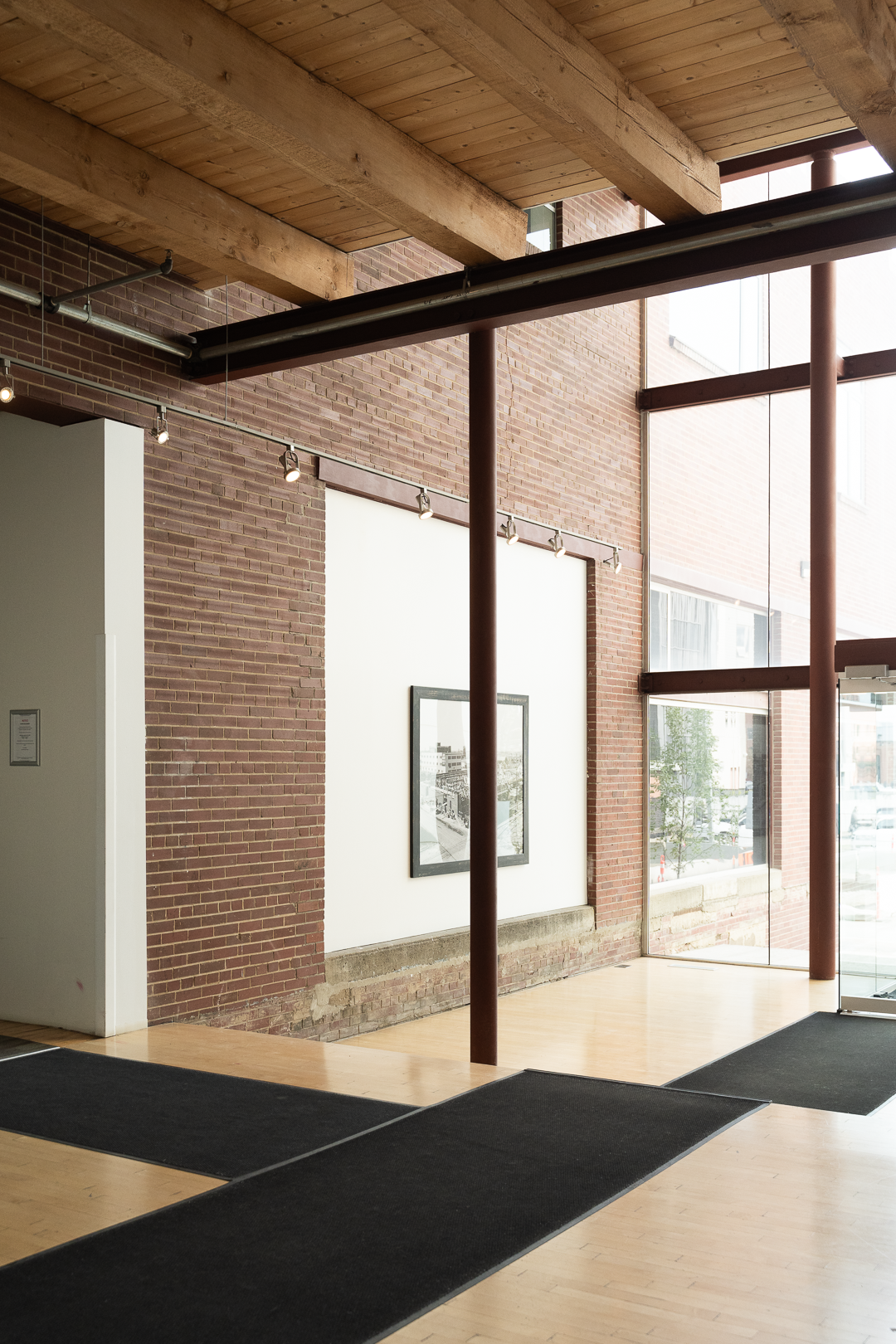
Exposed Brick Walls

Original sand lime or wire-cut red brick, hand-laid over a century ago. Impossible to authentically replicate.

Heavy Timber Beams

Original fir and cedar structural beams, typically 12–14 inches thick, spanning ceilings and often left fully exposed in the conversion.

Soaring Ceilings

Commercial warehouse floors required 12–16 feet of clearance. That industrial scale is now a defining residential luxury.

Chicago School Windows

Oversized window bays in grid facades, exemplified by the McLeod Building. Floods interiors with natural light.

Concrete and Steel Frames

Built during a boom era that prized fireproofing; reinforced concrete slabs and steel columns are structural features of most pre-WWI warehouses.

Loading Dock Heritage

Original rear-facing loading bays, railway spur access points, and freight elevator shafts preserved as architectural character.

Original Hardwood Floors

Maple, fir, or Douglas hardwood laid in the 1910s–1920s, now polished and showcased in many conversions.

Exposed Ductwork and Industrial Services

Pipes, conduit, and mechanical systems left visibly integrated into the ceiling plane, a signature of authentic warehouse conversions.

Data last updated on May 8, 2026 at 09:30 AM (UTC).
Copyright 2026 by the REALTORS® Association of Edmonton. All Rights Reserved.
Data is deemed reliable but is not guaranteed accurate by the REALTORS® Association of Edmonton.
The trademarks REALTOR®, REALTORS® and the REALTOR® logo are controlled by The Canadian Real Estate Association (CREA) and identify real estate professionals who are members of CREA. The trademarks MLS®, Multiple Listing Service® and the associated logos are owned by CREA and identify the quality of services provided by real estate professionals who are members of CREA.