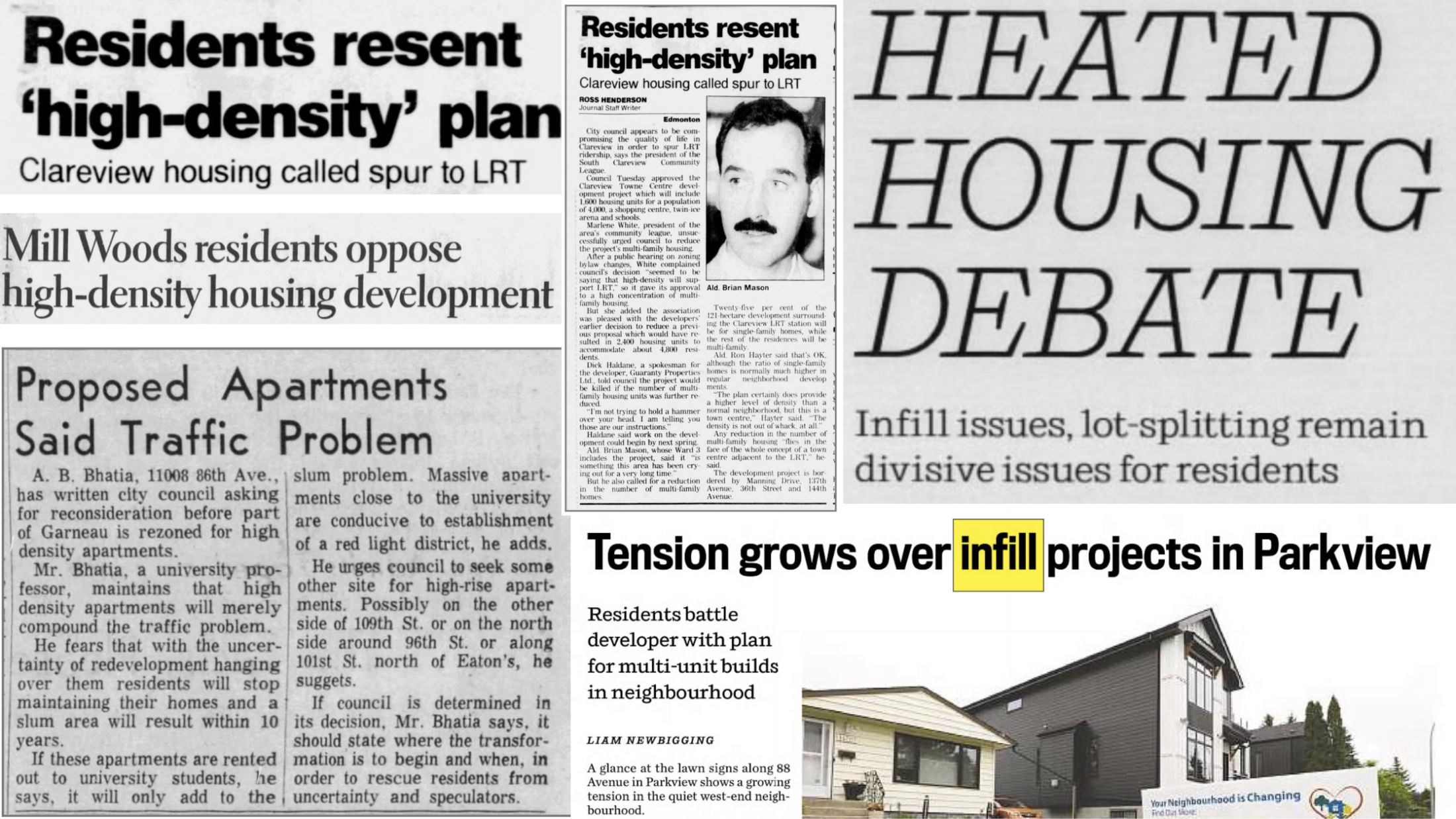
For more than 65 years, Edmonton has wanted the rewards of growth while fighting over who should have to accommodate the row houses, apartments, townhouses, skinny homes and now multiplexes that come with it.
Right now, we are protecting ourselves from multiplexes.
Homeowners across established neighbourhoods have turned to restrictive covenants to limit redevelopment, while the complaints around infill have remained remarkably consistent over the years: too tall, too many units, too many cars, not enough parking, lost trees, lost sunlight, lost privacy, construction and the increasingly distressing discovery that cities continue changing after we buy a house in them.
Somehow we have been surviving it against all odds for more than 65 years.
In 1960, Killarney residents petitioned against row housing, warning of a “wall effect.” In 1963, a Garneau resident warned that apartments would worsen traffic, destabilize the neighbourhood and might even help create a “red light district.” In 1968, 531 Londonderry homeowners opposed higher-density zoning, citing inadequate parks and apartment sites they said had not appeared on plans when they bought.
Garneau, remarkably, survived the red-light-district apocalypse. It survived so thoroughly that apartments once feared as threats are now simply part of Garneau.
Homeownership has a strange tendency to expand emotionally beyond the property line. The neighbour owns the lot, but surely we should retain some veto over how many kitchens appear on it. The street is public, but the parking space in front of our house has somehow become a treasured family heirloom. The empty lot belongs to somebody else, but we have been looking at it for twelve years, which frankly feels like equity.
Restrictive covenants take that instinct one step further. They attempt to extend today's preferences into the future, over property we may no longer own in a neighbourhood we may no longer live in.
We have arrived at one particular moment in a city barely more than a century old, looked around and apparently concluded: Yes. This is it. We nailed it. Everybody put your pencils down.
This Development Will Ruin the Neighbourhood. Again.
In 1991, Clareview residents fought a plan for 1,600 homes near the LRT. The logic was almost suspiciously straightforward: trains need passengers, and passengers are easier to find when they live near the train. More than three decades later, Edmonton still debates transit-oriented development as though somebody recently burst from a laboratory shouting, “Wait. What if we put the people near the transit?”
In 2001, Mill Woods residents fought higher-density housing on land they believed would remain open. One resident compared the development to a “sore.” An open field behind your house is lovely. The interesting part is how quickly somebody else's undeveloped property becomes an amenity we feel entitled to preserve.
By 2008, we had nearly perfected the argument. Neighbours opposed a Habitat for Humanity project in Beacon Heights, producing an Edmonton Journal headline worthy of framing: “Habitat's OK. It's the plan that neighbours oppose.” Affordable housing? Absolutely. Habitat for Humanity? Wonderful. Housing actual lower-income families here? Now we need to discuss compatibility.
Then came skinny houses. By 2017, homeowners were organizing restrictive covenants beneath signs declaring “NO LOT SPLITTING.” Two homes where there had been one required legal protection. Nine years later, two homes barely qualify as the emergency.
Now it is the multiplex.
Row housing. Apartments. Townhouses. Skinny houses. Multiplexes. For more than six decades, Edmonton has repeatedly discovered the precise form of housing that will finally destroy the neighbourhood.
Growth Is Wonderful Until It Needs an Address
Edmonton loves growth. We celebrate population records, court investment and cheer new employers, restaurants, flights and construction. We want more customers, more taxpayers and, conveniently, more demand for the real estate we already own.
The City is explicitly planning for a future Edmonton of two million people.
There is one small logistical problem with all this prosperity: the people are going to need homes.
They cannot live in the population forecast. The nurse cannot sleep in the economic-development strategy. The teacher cannot raise a family inside GDP growth. Eventually all these wonderful new Edmontonians have to stop contributing to the economy for the evening and go somewhere.
This is where our enthusiasm becomes strangely conditional. We want the nurse at the hospital, the teacher at the school, the tradesperson building our infrastructure, the server at the restaurant and the customer keeping the neighbourhood coffee shop alive.
We become less enthusiastic when they need an actual home.
Apparently the ideal new Edmontonian arrives, gets a job, pays taxes, supports local businesses, rides the LRT, increases our property value and then politely dematerializes somewhere around the Henday at bedtime.
We Want Our Houses to Get More Expensive. We Also Want People to Afford Them.
We want Edmonton to grow. More jobs, investment, businesses and people choosing to live here.
And when a city becomes more desirable, something wonderfully predictable happens:
Our homes become more valuable.
We track assessments, celebrate record sales and tell our friends what the house down the street sold for. If we bought for $400,000 and can sell for $800,000, we rarely call an emergency meeting about the affordability crisis occurring on our own land title.
But now our $800,000 asset is somebody else's $800,000 entry fee.
The same thing happens within the mature neighbourhoods people most want to live in. There is only one Glenora, one Garneau, one Highlands, one Belgravia, one Riverdale and one Westmount. We cannot manufacture another Highlands ten kilometres away. The mature trees, river valley, architecture, central location, schools, parks and decades of public investment are attached to the land.
More people want in. That demand helps make the homes we already own more valuable.
Great.
So we have two basic options: allow more households to share desirable land, or preserve the scarcity and let everyone fight over it.
One gives us more housing.
The other gives us excellent comparable sales.
Then somebody proposes the first option: a duplex, a skinny house, a row house, a multiplex.
Whoa. Not like that.
It will ruin the neighbourhood. Destroy the reason we chose to live here. This is a family neighbourhood.
Which raises an awkward question: what happens to a family neighbourhood when the families grow up?
Neighbourhoods age with the people who live in them. A young couple moves in. Children arrive. Five people fill the house. Twenty-five years pass. The kids grow up and leave. The parents stay.
The house that once held five now holds two, and eventually perhaps one. The house remains. The lawn remains. The mature elm remains. The bedrooms remain.
We preserved everything except the population.
Then we look down the street and wonder where all the kids went.
They grew up.
And now the next generation would quite like the opportunity to raise their families here too.
So somebody proposes adding more homes.
Oh.
A neighbourhood cannot age in place, shrink in household size, become increasingly expensive and add few homes while somehow remaining full of young families through the sheer force of community-league enthusiasm.
At some point, we have to decide whether a “family neighbourhood” means a place where the next generation of families can actually live, or a place preserved to resemble the moment when our families lived there.
We Hate Sprawl Until Infill Appears Next Door
Edmonton is too spread out. Infrastructure costs too much. Traffic is getting worse. Transit cannot efficiently serve everything. We should protect agricultural land and make better use of the roads, pipes, schools and services we already paid for.
Excellent. I'm in.
Then the excavator shows up next door.
Wait. NEXT DOOR?
A multiplex? Beside MY HOUSE?!
Suddenly the fiscal irresponsibility of endless suburban expansion deserves a more nuanced discussion.
Because sprawl has one enormous advantage: you can't see it from your kitchen.
Another subdivision is somewhere at the edge. Another sewer is underground. Another interchange is buried in a capital budget. Another twenty-minute commute belongs to somebody we will never meet. The costs are enormous, but pleasantly abstract.
So the housing moves outward. The roads and pipes follow. The cars follow the people. We spend more money extending the city because using more of the city we already built turned out to involve the deeply troubling possibility that something near us might change.
Then we look around at the traffic, infrastructure costs and endless outward expansion and arrive right back where we started.
Edmonton is too spread out.
We don't hate sprawl enough to accept the alternative. We just prefer its consequences where we can't see them.
We Want Urban Amenities Without the Urban Part
We want the good stuff: frequent transit, walkable streets, independent restaurants, coffee shops, grocery stores, safe bike routes, interesting main streets and the kind of neighbourhood where you can leave the car at home and still have somewhere to go.
A bus cannot run every ten minutes on good intentions. A restaurant cannot survive on neighbourhood character. A coffee shop cannot pay rent with mature elm trees. Transit needs riders. Businesses need customers. Walkability needs enough people and destinations close enough together to actually walk between them.
Then there is the physical space required for all these wonderful things. A bike lane takes space. So does a sidewalk. So does a tree. So does a bus lane. So does a moving car. So does a parked one.
Naturally, we would like all of them. Keep the trees. Widen the sidewalk. Add the bike lane. Improve transit. Maintain traffic flow. Do not remove parking.
I think Edmonton needs to invent a fourth spatial dimension.
We Fly to Europe to Admire the Things We Fight at Home
Edmonton became a city in 1904. Barely more than a century later, we already talk about some neighbourhoods as though we have completed them.
Which is particularly funny because we then spend thousands of dollars flying to cities that have been changing for centuries.
We wander through neighbourhoods where apartments sit above shops, buildings crowd narrow streets, patios consume sidewalks, trains are packed and parking is terrible. We drink a $14 glass of wine surrounded by five-storey buildings and announce that Europeans really understand cities.
Then we fly home and discover someone wants to build six homes next door.
Absolutely not. Think of the neighbourhood character.
But the cities we admire did not acquire character by resisting change. Their character is accumulated change: buildings added and demolished, houses divided, streets repurposed, transportation replaced and populations transformed.
What looks beautifully permanent to a tourist is often just disruption old enough that nobody remembers the public meeting.
Then, with absolutely no sense of irony, we organized to protect it from tomorrow.
We Do Not Eliminate the Cost. We Move It.
You are allowed to be against growth. If you want Edmonton to stop growing, say so. Fewer people. Less development. Less construction. Less change. Accept the consequences and make the argument.
What does not work is demanding the benefits of growth while insisting its physical consequences belong somewhere else.
When a neighbourhood blocks housing, the people who might have lived there do not disappear. They do not receive a polite email informing them that the neighbourhood has reached capacity and therefore cease requiring shelter.
They go somewhere else.
The housing moves. The commute moves. The infrastructure moves. The affordability pressure moves.
We do not eliminate the cost. We decide who else should absorb it.
And this is us discussing people who can afford housing. Our commitment to somewhere else becomes considerably more enthusiastic when the person needs supportive housing, a shelter or simply somewhere safe to sleep.
For more than 65 years, through petitions, hearings and impending neighbourhood catastrophes, Edmonton has become extraordinarily sophisticated at one particular solution.
Row housing? Somewhere else. Apartments? Somewhere else. Skinny houses? Somewhere else. Multiplexes? Somewhere else.
Affordable housing? Homeless Shelter?
Absolutely. We need it.
Just...
somewhere else.
Apparently Edmonton can become a city of two million people provided the additional residents have the courtesy not to live near anyone already here.
So oppose growth if that is what you believe. Have the courage to argue for the consequences too.
But if you want the jobs, investment, customers, amenities, tax base and rising value of the land you already own, the people creating that prosperity have to exist somewhere after business hours.
And they take up space.
About the author: Caitlin Heine is an Edmonton REALTOR® and founder of Iconic YEG. She has worked in Edmonton real estate since 2017, with a particular focus on the established and central neighbourhoods where many of the city's conversations about infill, redevelopment and housing change are happening.
