Edmonton's $1 land debate, its complicated relationship with density, and the economics of building a neighbourhood people genuinely want to live in.
On June 24, 2026, approximately 80 people gathered at the Knottwood Community League in Mill Woods to explore a legal means of preventing higher-density housing from being built in their neighbourhood. Residents met with a lawyer to discuss restrictive covenants, legally binding restrictions registered against property titles that can limit what future owners are permitted to build, even after the original homeowners have sold their properties. Concerns about traffic, parking, garbage and the changing character of established neighbourhoods motivated the initiative. Similar efforts have been underway in several other Edmonton communities.
It is an interesting time to be watching Edmonton grow. While some established neighbourhoods are organizing to restrict new housing, the City of Edmonton owns approximately 536 acres of centrally located land specifically intended to accommodate thousands of new residents. It has access to public transit, proximity to downtown, an established post-secondary institution next door and the rare opportunity to design an entire urban community from the ground up.
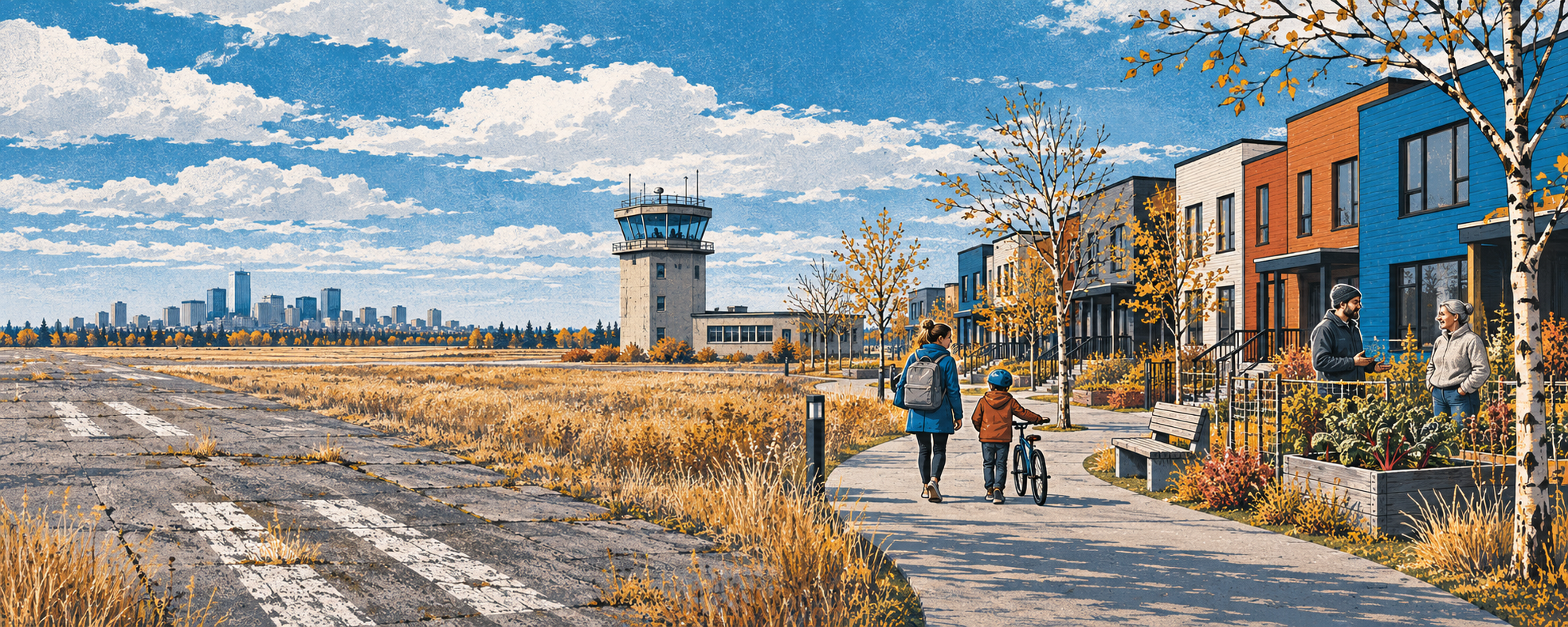
That neighbourhood is Blatchford, the former Edmonton City Centre Airport, which permanently closed in November 2013. More than a decade later, much of the land remains undeveloped.
Now, Kehewin Cree Nation has proposed acquiring approximately 36 acres of Blatchford for one dollar to establish an urban reserve that would include housing, businesses, childcare, health services and community gathering spaces. The proposal has reignited questions about the financial viability of Blatchford, the value of publicly owned land and what Edmonton should ultimately be trying to accomplish there.
As a real estate professional, I find myself asking a slightly different question. In a city where so many established neighbourhoods are resisting additional housing, why hasn't our most ambitious purpose-built urban neighbourhood become one of Edmonton's most desirable places to live?
Perhaps we have spent too much time discussing how many people Blatchford could accommodate and too little time considering what would make people want to be there in the first place.
[Source: CityNews – Mill Woods residents explore restrictive covenants to fight infill]
How Edmonton Ended Up With 536 Acres in the Middle of the City
For anyone relatively new to Edmonton, the idea that we once operated an airport just northwest of downtown might seem peculiar.
Blatchford Field opened in 1927 and played an important role in connecting Edmonton to northern communities. The airport existed long before much of the surrounding city. As Edmonton grew, residential neighbourhoods, businesses and educational institutions developed around it. Eventually, the very location that made the airport convenient became a limitation on the city's growth.
In 1995, Edmontonians voted in favour of consolidating commercial passenger flights at Edmonton International Airport. Private and general aviation continued at the municipal airport until city council voted in 2009 to proceed with a phased closure. The last plane departed on November 30, 2013.
Consider how difficult it would be for any established North American city to assemble 536 contiguous acres of centrally located land today. Edmonton had the opportunity to build an entire community without demolishing existing residential neighbourhoods, displacing homeowners or extending the city's boundaries farther into agricultural land.
The vision was ambitious: a sustainable urban community accommodating up to 30,000 residents, with a mix of housing, businesses, parks, community amenities and public transportation. Buildings would be energy-efficient, residents would be less dependent on vehicles, and everyday destinations would be accessible on foot.
Edmonton could demonstrate what a modern Canadian urban neighbourhood might look like if we had the opportunity to start over.
We had already gone to the considerable trouble of moving the airplanes.
[Sources: Edmonton Airports History | City of Edmonton – Blatchford Redevelopment | Original Blatchford Business Case]
The City of Edmonton Is Also the Developer
The City of Edmonton is more than the municipal authority responsible for approving development at Blatchford. It is also the landowner and developer.
The City prepares the land, installs roads and utilities, establishes development requirements and sells serviced parcels to private builders. Those builders finance construction, build the homes and ultimately sell or rent them to consumers. Proceeds from land sales are intended to help finance subsequent stages of development.
The City needs builders to purchase land. Builders need consumers to purchase homes. Consumers need sufficient confidence in the neighbourhood to justify their investment.
Unfortunately, they are all working on different timelines.
A municipality can plan a neighbourhood over several decades. A developer needs to know whether a project will sell within a reasonable period. A homebuyer committing several hundred thousand dollars wants to know what their life will look like when they move in.
A thirty-year development timeline might be perfectly reasonable in a municipal planning document. It is considerably less attractive to someone whose children are currently six and eight.
What Has Actually Been Built at Blatchford?
The first residents moved into Blatchford in 2020, approximately four years later than originally anticipated.
In October 2026, Blatchford celebrated the completion of Pilot, a 90-home rental townhouse development. Seven apartment buildings planned within the current development stages could collectively introduce approximately 700 additional homes.
The NAIT/Blatchford Market LRT station opened in 2024, and a second station, Blatchford Gate, has already been constructed. Its opening is dependent on future transit service requirements.
At Littlewood Park, the former airport control tower overlooks community gardens, a playground, gathering areas and a skating rink during the winter.
According to CityNews reporting on November 25, 2026, approximately 400 homes were completed or under construction at the end of 2025, with another 780 planned on land already sold.
Research from BILD Edmonton Metro and the Edmonton Chamber of Commerce indicated that less than one-third of the neighbourhood's land had been serviced and made available to builders since the development plan was established.
A child born on the day the airport closed would now be entering their teenage years. The neighbourhood intended to accommodate 30,000 people is still largely in its infancy.
[Sources: Blatchford Rental Development Update | Littlewood Park | Metro Line LRT Expansion]
The Difference Between Buying a Home and Buying a Promise
Many Edmontonians will remember the original excitement surrounding Blatchford's proposed recreational lake. A centrally located, environmentally progressive neighbourhood with a lake and substantial recreational amenities would have offered something relatively unique in Edmonton.
In 2014, city council approved a scaled-back version of the development. In 2015, administration recommended against proceeding with the recreational lake, citing costs, timing and conflicts with other development objectives.
Construction costs change. Financial circumstances evolve. Governments revise their priorities. Unfortunately, buyers tend to remember the attractive parts of the original proposal, even after they have been removed from the budget.
Imagine you are considering purchasing a $600,000 townhouse in Blatchford. You like the architecture, appreciate the energy-efficient construction and enjoy the central location. You also have several alternatives elsewhere in Edmonton.
What distinguishes this property from the others?
As a REALTOR®, I see buyers assign considerable value to the neighbourhood surrounding a property. They want to know where they will walk their dog, where they will get coffee, how they will spend their weekends and whether they can envision themselves becoming part of the community.
There is a considerable difference between buying a home within walking distance of a recreational lake and buying a home within walking distance of a historical discussion about a recreational lake.
Your mortgage payments begin at possession either way.
[Sources: Global News – Edmonton scales back Blatchford redevelopment | City of Edmonton – Blatchford]
What the Edmonton Real Estate Market Is Telling Us
On November 26, 2026, I reviewed publicly recorded MLS® residential sales in Blatchford.
These figures do not represent every transaction in Blatchford. Developers can sell homes directly to consumers without listing them on the MLS® system, and the data does not account for rental households. Nevertheless, recorded residential sales have more than doubled compared with last year.
Builders in Blatchford must work within specific environmental and construction requirements that differ from conventional residential development. They are also competing for financing, labour, materials and customers with developers across the Edmonton region.
According to CMHC, Edmonton-area housing starts declined approximately 20% in the first half of 2026 compared with the same period in 2025, while newly constructed rental properties were taking longer to lease.
A builder can be genuinely enthusiastic about environmental sustainability and still have a lender who is considerably more enthusiastic about the repayment schedule. Similarly, a buyer's commitment to reducing their environmental footprint does not automatically increase their mortgage qualification.
Blatchford's development pace cannot simply be attributed to a lack of interest in sustainable urban living. Land availability, construction requirements, financing conditions, affordability and competition all influence what gets built and when.
[Sources: ICONIC YEG MLS® market review, November 26, 2026 | CMHC Housing Supply Report | Taproot Edmonton – Blatchford's development challenges]
Edmonton's Complicated Relationship With Density
In January 2024, Edmonton introduced a new zoning bylaw that expanded the types of housing permitted in established residential neighbourhoods. The changes were intended to accommodate population growth, diversify housing options and make more efficient use of existing municipal infrastructure.
Residents across Edmonton have since organized against infill developments, expressing concerns about parking, privacy, traffic, mature trees and the scale of new construction. Several communities, including Duggan and Rideau Park, have pursued restrictive covenants to limit future development on privately owned land.
In October 2026, Alberta's UCP government directed Edmonton to reverse significant elements of its small-scale residential zoning regulations. The provincial order requires amendments to permitted uses, density, building heights and minimum parking requirements by January 22, 2027.
As I explored in my earlier article, Edmonton's Great Housing Plan: Everybody Should Live Somewhere Else, resistance to neighbourhood development is hardly new.
In 1960, Killarney residents objected to row housing. In 1991, Clareview residents opposed a proposed development of 1,600 homes near the LRT.
We seem particularly fond of the version of Edmonton that existed shortly after we personally secured our place in it.
There are understandable reasons to protect mature trees, architectural character and established streets. However, preserving the physical appearance of a neighbourhood does not necessarily preserve the life that once existed within it.
Children grow up. Households become smaller. School enrolment changes. Local businesses lose customers. The bungalow that once accommodated a family of five might now accommodate one person.
Eventually, we could succeed in preserving every bungalow on a street while ensuring that very few of the children raised on it can afford to return.
The houses would still look lovely.
As Edmonton continues to debate the introduction of new housing into established neighbourhoods, Blatchford offers an alternative. Hundreds of acres were deliberately set aside to accommodate urban growth without requiring extensive redevelopment of existing residential streets.
But permission to build housing does not oblige anyone to move there.
[Sources: Global News – Restrictive covenants in south Edmonton | Edmonton's zoning changes and the provincial directive]
What Do the World's Most Interesting Neighbourhoods Have in Common?
Consider the communities featured in Time Out's 2026 neighbourhood rankings. Seoul's Jongno 3-ga is known for its food stalls, small businesses and intimate network of streets. Rabat's L'Océan offers cafés, waterfront gathering spaces and a distinct local identity. Chinatown in Los Angeles combines cultural institutions, restaurants, galleries and entertainment with a 32-acre public park.
These places are shaped by different cultures, climates, histories and economies.
What they share is an abundance of reasons to leave the house.
Interestingly, few international travel publications dedicate entire features to the world's most impressive collection of uninterrupted residential driveways.
Population density creates the customer base necessary to support local businesses, public transportation, cultural institutions and recreational facilities. A neighbourhood with thousands of residents within walking distance of a bakery gives that bakery a considerably better chance of remaining open on a Wednesday afternoon.
But density alone cannot guarantee an interesting neighbourhood. We are perfectly capable of building hundreds of homes in close proximity and giving the people living in them absolutely nothing to do.
The appeal of these places lies in the relationship between their population, public spaces and economic activity. People can participate in the life of the neighbourhood without having to own every amenity they enjoy.
[Source: Time Out's 2026 Coolest Neighbourhoods in the World]
Somewhere Along the Way, We Started Confusing Privacy With Quality of Life
I live in Riverdale, one of Edmonton's oldest central neighbourhoods. If I were selling you my own home and simply provided its square footage, lot dimensions and number of bedrooms, I would be leaving out a considerable portion of what makes living there valuable to me.
Much of what I love about my neighbourhood exists beyond my property line. The river valley, walking trails, community rink, mature trees, local businesses and familiar faces I encounter on my morning walks are all part of my experience of living there.
Edmonton has historically placed considerable value on private space. A larger house, a larger garage and a larger backyard have often been presented as natural indicators of an improved quality of life.
I enjoy my backyard. I also wonder how much responsibility we have assigned to individual households to provide everything that a healthy community might otherwise offer collectively.
We purchase our own play equipment, maintain our own recreational spaces and surround them with six-foot fences. We drive from our private homes to organized activities, often passing hundreds of neighbours we have never met.
Then we reminisce about a time when children knew everyone on their street, neighbours looked out for one another and people felt a stronger sense of community.
Where, exactly, are those relationships supposed to develop?
A community rink, a public playground or a neighbourhood café creates opportunities for repeated, informal encounters. Over time, the stranger tying their skates beside you becomes someone you know.
I keep coming back to that meeting in Mill Woods.
When approximately 80 Edmontonians wanted to meet their neighbours, discuss an important issue and organize around a common interest, they went to their community hall.
Apparently, even the defence of the private backyard requires a little shared space.
What Is Kehewin Cree Nation Proposing for Blatchford?
Kehewin Cree Nation, located northeast of Edmonton, has proposed acquiring approximately 14.5 hectares, or 36 acres, of Blatchford land adjacent to the future Blatchford Gate LRT station for a nominal purchase price of one dollar.
The proposed development, known as Eagle's Landing, would establish an urban reserve.
An urban reserve is land located within or near a municipality that is formally designated as reserve land for a First Nation through a federal process. Establishing one involves more than a municipal land transaction. It can require federal approval, servicing arrangements and agreements between the participating governments.
Kehewin's preliminary vision includes residential development, businesses, hospitality facilities, community gardens, healthcare services, childcare and governance facilities.
For members of Kehewin Cree Nation living in Edmonton, the development could provide opportunities to access culturally appropriate services, establish businesses, find employment and participate in a community shaped by their own Nation.
Urban reserves are an established model of Indigenous economic development in Canada. In Saskatoon, Muskeg Lake Cree Nation established its first urban reserve in 1988. By 2024, the City of Saskatoon reported that it accommodated approximately 50 businesses and more than 750 employees.
Kehewin's proposal has its own economic circumstances, planning requirements and financial considerations, but we have decades of Canadian experience to draw upon.
[Sources: Lakeland Connect – Kehewin Cree Nation proposes urban reserve in Edmonton | City of Saskatoon – Muskeg Lake Cree Nation Urban Reserve Agreements]
Is Selling Public Land for One Dollar Financially Irresponsible?
The City of Edmonton has already invested considerable resources in Blatchford. Future land sales are intended to recover development costs and finance additional infrastructure. A sale substantially below market value could compromise those financial assumptions.
The proposed development also differs from Blatchford's current master plan in its anticipated residential density, land uses, infrastructure requirements and energy demands.
The Blatchford Renewable Energy Utility introduces another consideration. The neighbourhood's district energy system was designed to serve a substantial population, with revenue from connected properties intended to support infrastructure and operating costs.
With fewer buildings connected than anticipated, the utility faces significant financial challenges.
Edmonton's draft four-year capital budget includes approximately $131 million in additional Blatchford land development spending, expected to be financed through land sales. Separately, the renewable energy utility is seeking a non-refundable contribution of $79 million by 2028.
Kehewin has also yet to complete a detailed financial feasibility assessment. The Nation has indicated that it would like the City to demonstrate a willingness to proceed before committing substantially more resources to planning.
But there is another financial question that seems to receive considerably less attention.
What is the economic cost of allowing centrally located land to remain undeveloped?
Vacant municipal land may have considerable market value on paper. In its current state, it generates no residential property tax revenue, supports no local businesses and accommodates no households.
According to the City Auditor's report, Edmonton had sold approximately 16.3 hectares of Blatchford land by the end of 2023, compared with a forecast of 20.1 hectares. Of the land sold, approximately 12.5 hectares went to NAIT.
In real estate, there is a difference between the theoretical value of an asset and the value that can be realized within a reasonable period. I can list a property for virtually any price. The existence of that price does not necessarily mean someone is coming with a cheque.
If Edmonton retains the 36 acres, when does it realistically expect to sell them? How much additional investment will be required? Who is likely to finance construction, and when will the first residents move in?
If Edmonton pursues the Kehewin proposal, what could be developed first? What infrastructure would be necessary? What economic activity could it generate?
Comparing the immediate cost of one proposal with the most optimistic long-term financial outcome of another is a rather convenient way of conducting a financial analysis. It is considerably less useful when trying to make a real estate decision.
[Sources: Taproot Edmonton – Blatchford and the municipal budget | CityNews – Edmonton's Blatchford gets $131 million in draft budget | City of Edmonton Auditor – Blatchford Development Performance Management Audit]
The Value of Developing the Land Next Door
Everyone wants to invest in a successful neighbourhood. Far fewer people want to be personally responsible for getting one started.
My experience in residential real estate and rental development has taught me how much confidence influences purchasing decisions. People are generally more comfortable committing their money when they can see evidence of others committing theirs.
When prospective buyers express enthusiasm for neighbourhoods like Highlands, Ritchie or Old Strathcona, they often have an existing relationship with those places. They have attended events, visited restaurants, walked the streets or spent time in the surrounding parks.
Their interest in the neighbourhood predates their interest in buying a home there.
What if people were visiting Blatchford for reasons entirely unrelated to real estate? To attend a cultural event, meet friends for dinner, access a service or spend an afternoon with their children?
Those visitors become potential customers for businesses. Businesses create employment and daily activity. Established amenities make surrounding housing more attractive.
From a land development perspective, the potential effect of Eagle's Landing on the remaining acreage deserves examination alongside the proposed purchase price.
A successful development on those 36 acres could improve the marketability of the surrounding land, attract additional private investment and support existing Blatchford homeowners. The extent of that benefit remains to be established, but assigning it a value of zero is also a financial assumption.
The best marketing campaign a neighbourhood can have is a collection of people who enjoy being there.
What If Blatchford Became a Destination for Green Space?
I would also like to see Edmonton dedicate more of Blatchford to permanent, substantial public green space.
One of the advantages of higher-density housing is the opportunity to accommodate more people on a smaller portion of land, leaving room for shared amenities and natural spaces.
A generous public park can provide recreational opportunities for thousands of households, including people living in apartments, townhouses and smaller homes. It can support biodiversity, provide shade during increasingly hot summers and offer spaces for community events, exercise and outdoor education.
Public green space also matters economically.
Consider the value Edmontonians place on homes near the river valley. Buyers routinely seek out properties with access to natural areas, trails and parks, and those features can command a premium.
The homeowner does not own the river valley. They benefit from living near it.
As a REALTOR®, I have yet to meet a buyer who expressed disappointment upon discovering that a beautiful park was accessible from their front door without being their personal responsibility to maintain.
Why would we overlook the potential of public green space to enhance surrounding property values when evaluating the development of Blatchford?
Energy-efficient buildings and renewable energy infrastructure are important components of an environmentally responsible neighbourhood. So are trees, biodiversity, reduced vehicle dependence and access to nature.
A major public park could become a defining feature of Blatchford and one of the few opportunities Edmonton has left to create substantial new public green space this close to downtown.
Where Does Edmonton Go From Here?
I support the City of Edmonton pursuing discussions with Kehewin Cree Nation regarding Eagle's Landing. I also support dedicating more land within Blatchford to permanent public green space.
Kehewin's ambitions for its own members deserve consideration independently of what the development might do for surrounding property values. Indigenous economic development, self-determination and access to culturally appropriate services have value in their own right.
From a real estate perspective, I am interested in what these proposals could contribute to the broader success of Blatchford.
There is still substantial land available to accommodate residential development and an opportunity to create a dense, sustainable urban community. After more than a decade, we can reasonably revisit some of the assumptions underlying the original plan without abandoning those objectives.
A development plan is a tool for achieving an outcome. Its continued existence should hardly be confused with the achievement of that outcome.
Edmonton has a history of debating where people should live, what they should live in, how much space they should occupy and, increasingly, what the people who purchase our homes after we are dead should be permitted to do with them.
We might benefit from spending a little more time thinking about how we want to live together while we are still here.
Before another decade passes, I would like us to be able to complete a much simpler sentence:
Five years from now, you should take your family to Blatchford because you will be able to...
How many of us could confidently finish that sentence today?
We closed an airport to create a neighbourhood.
I would quite like to see what happens when we start giving people reasons to go there.
About the Author
Caitlin Heine is an Edmonton REALTOR® with RE/MAX Real Estate and the owner of ICONIC YEG. Her work in residential real estate, rental housing and community development informs her perspective on housing demand, neighbourhood design and long-term property value.
If you live in Blatchford, have considered purchasing a home there or have chosen another Edmonton neighbourhood instead, I would genuinely be interested in hearing what influenced your decision.
Contact Caitlin Heine at ICONIC YEG
Further Reading: Edmonton's Great Housing Plan: Everybody Should Live Somewhere Else